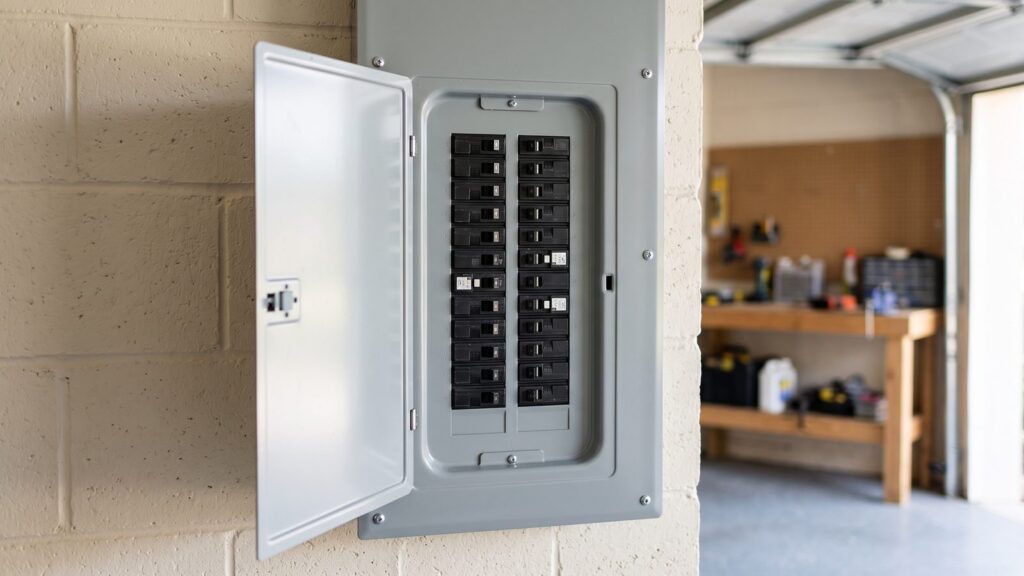
What Does an AFCI Breaker Do?
An AFCI (arc-fault circuit interrupter) breaker shuts off a circuit when it detects electrical arcing, the sparking that happens at damaged wires and loose connections and can start a fire inside a wall. A standard breaker only reacts to overloads and short circuits. An AFCI adds electronics that recognize arcing and cut the power before it builds enough heat to ignite anything.
October is Fire Prevention Month, which makes it a good time to understand the one device in your panel designed specifically to prevent electrical fires, and to make sense of it if yours keeps tripping.
What counts as an arc fault
An arc is electricity jumping across a gap it was never meant to cross. It happens when insulation is worn or pierced, when a connection works loose, or when a cord is pinched behind furniture or crushed under a rug. The arc itself is small, but it is extremely hot, and it can smolder against wood framing or insulation for a long time without drawing enough current to trip an ordinary breaker. That gap in protection is the reason AFCIs exist.
AFCI vs. GFCI: fire protection vs. shock protection
The two are easy to confuse because both have a test button. They do different jobs. A GFCI watches for current leaking to ground, which is what happens when electricity passes through water or a person, and it protects against shock. An AFCI watches for arcing and protects against fire. Our guide covers how GFCI outlets protect you from shock. Many rooms in a modern home need both kinds of protection.
Where Are AFCI Breakers Required in Florida Homes?
Florida currently enforces the 2020 National Electrical Code through the Florida Building Code, 8th Edition. It requires arc-fault protection on the 15- and 20-amp, 120-volt circuits that serve most living spaces: kitchens, living and family rooms, dining rooms, bedrooms, dens, closets, hallways, laundry areas and similar rooms. Bathrooms, garages and outdoor areas are not on that list.
Two details surprise people. First, the rule covers the whole circuit, not just the wall outlets, so the lights, smoke alarms and built-in appliances on those circuits are included. Second, the code asks for arc-fault protection, and a breaker is only one way to provide it. A new edition of the Florida code is scheduled to take effect at the end of 2026, so the specifics here describe the rules as of October 2026.
New construction, additions and extended circuits
Every new home is built with arc-fault protection on the circuits listed above. The same applies to an addition, and to any existing circuit that is extended into new space. If you add a bedroom, finish a room or run new outlets off an existing circuit, that circuit has to be brought up to the current rule as part of the permitted work.
When you replace or modify wiring in an older home
Older homes are not required to be rewired just because the code changed. Circuits that nobody touches can stay as they are. The requirement arrives with the work:
- Modifying or extending a circuit in one of the listed rooms means that circuit needs arc-fault protection. There is a narrow exception for extending existing wires a short distance without adding any outlets.
- Replacing an outlet in one of the listed rooms means the replacement has to be arc-fault protected, either by an AFCI outlet or by an AFCI breaker on that circuit. The Florida Building Code for existing buildings points directly to this rule.
Whether replacing the panel by itself triggers the requirement for every circuit is a question the local building inspector answers, so ask before the job is priced.
Why Does My AFCI Breaker Keep Tripping?
An AFCI trips for one of four reasons: it detected real arcing, something plugged in produces an electrical signature that resembles arcing, the circuit has a wiring condition the breaker cannot tolerate, or the breaker itself has failed. Only the first is the hazard it was built for, but all four deserve a proper look.
A real arc: damaged cords, loose connections, a nail through a wire
This is the breaker doing its job. Common sources are a lamp or extension cord with cracked insulation, a worn outlet that no longer grips a plug, a loose wire on a switch or outlet, and a picture nail or screw that caught a cable inside the wall. If the trips started right after hanging something, moving furniture or doing a small repair, start there.
Motors and electronics that confuse older AFCIs
Some equipment sparks a little as part of normal operation. Vacuum cleaners, treadmills and older power tools use motors with brushes, and certain dimmers and electronic power supplies produce electrical noise. Early AFCI breakers were more easily fooled by these than current ones. A clue is a breaker that trips only when one particular device is running.
Shared neutrals and wiring mistakes
AFCIs are far less forgiving of wiring shortcuts than standard breakers. Two circuits that share one neutral wire, a neutral touching a ground wire somewhere down the line, or neutrals from different circuits tied together in a box will all make an AFCI trip, sometimes immediately and sometimes at random. These conditions often sat unnoticed for decades until an AFCI was installed on the circuit.
When the breaker itself has failed
An AFCI contains a small circuit board, and electronics wear out, especially in a hot, humid Florida garage. A breaker that trips with nothing connected to the circuit, will not reset at all, or does not trip when you press its test button needs to be replaced.
What to Do When an AFCI Trips (and When to Stop Resetting It)
Work through it in order:
- Unplug everything on the circuit and switch off its lights.
- Reset the breaker by pushing it fully to OFF, then to ON.
- If it holds, plug devices back in one at a time, a few minutes apart. The one that trips it, or its cord, is your suspect.
- If it trips with nothing plugged in, the problem is in the wiring or the breaker.
Stop resetting and call an electrician if the breaker trips again right away, if it trips with nothing connected, or if you notice a burning smell, a warm outlet or cover plate, buzzing, or scorch marks. Do not replace an AFCI with a standard breaker to make the tripping stop. That removes the protection without fixing whatever caused it.
Should You Add AFCI Protection to an Older Palm Beach County Home?
You are not required to add arc-fault protection to existing circuits that nobody is altering. It is still worth considering in an older home, because aging wiring and worn connections are exactly where arcing starts, and the requirement applies anyway the moment a circuit is extended or an outlet is replaced.
What it takes depends on a few things:
- The panel. AFCI breakers are made for specific panel models. A current panel accepts them easily. An obsolete one may not accept them at all.
- The wiring. Shared neutrals and old splices have to be found and corrected first, or the new breakers will trip.
- The number of circuits. Bedrooms and living areas are the usual priority.
The simplest time to add it is during a panel change, when every circuit is already being reconnected. Our cost guide explains what a panel upgrade typically includes, and our service page covers electrical panel replacement and upgrades.
Frequently Asked Questions
Can I replace a regular breaker with an AFCI myself?
We do not recommend it. The work is done inside an energized panel, the AFCI has to be the exact type listed for that panel, and it connects to the neutral differently than a standard breaker. If the circuit has a shared neutral or a wiring error, the new breaker will trip from the first minute and you will be troubleshooting inside the panel.
Do AFCI breakers work in older panels like Federal Pacific or Zinsco?
Generally, no. AFCI breakers are built and listed for specific modern panel lines, and those two brands have been out of production for decades. In a home with one of these panels, arc-fault protection usually means AFCI outlets installed at the start of each circuit or, more often, replacing the panel. Federal Pacific and Zinsco panels can usually be identified from the label inside the panel door.
What is the difference between an AFCI breaker and an AFCI outlet?
An AFCI breaker sits in the panel and protects the entire circuit from the start. An AFCI outlet protects the wiring and cords from that outlet onward, but not the run between the panel and the outlet. The code allows an AFCI outlet in specific situations, such as replacing an outlet or extending a circuit in an older home.
Are dual-function AFCI/GFCI breakers worth it?
Often, yes. A dual-function breaker provides arc-fault and ground-fault protection in one device, which is useful on circuits that need both, such as kitchens and laundry areas. Note the wording: a “combination” AFCI is not the same thing. That term means the device detects two kinds of arcing, not that it includes GFCI protection.
Talk to a Licensed Electrician About Arc-Fault Protection
If an AFCI keeps tripping and the steps above did not find the cause, or you want to know what arc-fault protection would involve in your home, Kasper Electrical can help. An electrical safety inspection will show which circuits are protected, what condition the wiring is in and whether your panel can accept AFCI breakers. Request an appointment to get started.
Sources: Florida Building Commission; Florida Building Code, Existing Building, 8th Edition (2023); Leviton product support. All read October 2026.
Written by the Kasper Team at Kasper Electrical Inc. — Florida Certified Electrical Contractor EC0001409, serving Palm Beach and Martin Counties since 1978. Last updated: October 6, 2026.