How Often Should a Dock’s Electrical System Be Inspected?
Have a dock’s electrical system inspected at least once a year, and again after any hurricane, tropical storm or storm surge that reaches the dock. BoatUS recommends an annual inspection for private docks, and the Electric Shock Drowning Prevention Association adds an inspection after periods of violent weather. Test the dock’s GFCI protection monthly in between.
Hurricane season ends on November 30, which makes November and December the natural time to do it. The summer’s storms are behind you, the boating season is starting, and anything the weather loosened, corroded or flooded is still fresh enough to find. This checklist covers what to look at yourself and what to leave to an electrician.
What Salt Air and Storm Surge Do to Dock Wiring
A dock’s electrical system lives in the harshest conditions any wiring on your property will see: constant salt spray, standing humidity, direct sun and, a few times a decade, seawater over the boards.
Corrosion at terminals, breakers and receptacles
Salt settles on every surface and pulls moisture out of the air. Over time it eats into copper and brass, so connections that were tight when installed become crusted and loose. Corrosion shows as a green or white powdery buildup on terminals and receptacle contacts. A loose, corroded connection heats up under load, and that heat is where melted plugs and scorched receptacles come from.
Equipment that was splashed or submerged
If storm surge or a very high tide reached the pedestal, the disconnect or any dock receptacle, that equipment needs an electrician’s evaluation before it is used again. Salt water leaves conductive residue inside devices even after they look dry, and breakers, GFCIs and receptacles that have been underwater are usually replaced rather than reused. The same caution applies to the house side of the system after a storm, covered in our guide to what to do with your electrical system after a hurricane.
Loose conduit, straps and damaged cord routing
Wind, waves and boats bumping the dock all shake things loose. Walk the length of the dock and look for conduit that has pulled away from its straps, cracked fittings, cables hanging below the boards where water can reach them, and shore power cords that are crushed, kinked or lying in standing water.
The Annual Dock Electrical Checklist
Most of this is a visual walk-through. Look, but do not open covers or touch anything that shows damage.
Pedestals and shore power receptacles
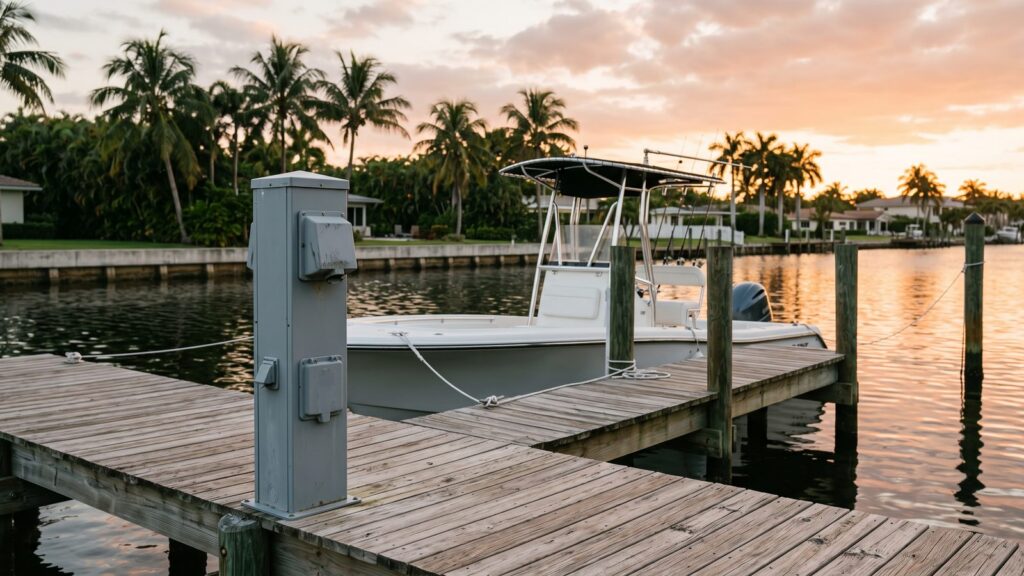
Check that every receptacle cover closes and seals, that the housing has no cracks, and that the inside is dry. Look at the contacts in each shore power receptacle. Blackened, pitted or melted contacts, or a shore cord plug that has discolored at the pins, mean the connection has been overheating. That receptacle should not be used until it is replaced. If you are planning a new pedestal, the choice of 30-amp vs. 50-amp shore power depends on the inlet on the boat you keep at the dock.
Ground-fault protection: test it, don’t assume it
Ground-fault protection is the device that shuts power off when current is leaking where it should not, and on a dock that leakage can end up in the water. Press the TEST button on every GFCI outlet and breaker that serves the dock. The power should cut off immediately. Then press RESET. A device that does not trip when tested is not protecting anyone. Newer docks are built with ground-fault protection on their circuits, while older docks often predate it, so if you cannot find any, that is the first thing to ask an electrician about.
Dock and underwater lighting
Check that every light works, that lenses are intact and sealed, and that no fixture has water inside it. For underwater lights, look at the cords where they leave the fixture and where they attach to the dock. Chafed or cracked cord jackets are common, and they are exactly where current can reach the water. Lights that flicker or only work some nights point to a loose or corroded connection. Dock lights not working at all usually trace back to a tripped GFCI, a failed photocell or timer, or corrosion at a connection.
Feeders, disconnects and the panel that serves the dock
Power usually reaches the dock through a feeder from the house panel or a separate panel near the seawall. Make sure the dock’s disconnect is easy to reach and clearly labeled, so anyone can shut the dock off quickly. Look for rust on panel enclosures, missing knockout plugs, and any section of the feeder that is exposed where it should be buried or in conduit.
Motor circuits and other dock equipment
Lift motors, pumps, fish-cleaning stations and anything else wired on the dock gets the same look: dry, sealed, firmly mounted, with no cracked cords and no corrosion at the connections. Equipment that hums, runs slowly or trips its breaker should be checked before the next time you rely on it.
Warning Signs to Act On Now
Current leaking into the water around a dock is what causes electric shock drowning, which is why these signs matter. Do not wait for the annual inspection if you notice any of these:
- A tingle or mild shock in the water near the dock, or when touching a ladder, railing or lift.
- A GFCI or pedestal breaker that keeps tripping.
- A scorched, melted or discolored receptacle or plug.
- A shore cord or plug that feels warm.
- Buzzing from a pedestal or panel, or dock lights that flicker.
Anyone who feels a tingle in the water should swim back the way they came, away from the dock, and get out without grabbing a metal ladder if possible. Then shut off the dock’s power. If someone in the water seems to be in trouble, do not jump in after them. Shut off the power, throw a flotation device and call 911. The National Fire Protection Association and BoatUS both advise against swimming near any dock that has electrical power.
What a Licensed Marine Electrician Checks
A homeowner’s walk-through catches visible damage. An electrician tests what you cannot see: whether every connection is tight and free of heat damage, whether ground-fault protection trips at the right moment, whether the grounding and bonding are intact, and whether any equipment is leaking current. They also open the pedestals and panels you should not, and replace corroded parts before they fail.
Kasper Electrical’s onshore marine electricians work on dock power, pedestals and shore power for waterfront homes in Palm Beach and Martin Counties.
Frequently Asked Questions
Can I reset a dock GFCI that keeps tripping?
Once. Unplug everything on that circuit, including any boat, and press RESET. If it trips again, leave it off and have it checked. A dock GFCI that keeps tripping is telling you current is leaking somewhere, which is exactly the problem it exists to catch. Keep everyone out of the water near the dock until the cause is found.
Does storm surge mean dock wiring must be replaced?
Not always, but anything that sat in salt water has to be checked before it is turned back on. Devices such as receptacles, GFCIs and breakers are usually replaced, because salt residue stays inside them. Wiring in sealed conduit may be reusable once it has been dried and tested. An electrician can tell you which is which.
Do I need a permit to repair dock wiring?
In most cases, yes. Adding or replacing a pedestal, running new wiring or upgrading the feeder needs an electrical permit. Swapping a worn receptacle or light fixture for the same type may not. Your building department decides, and many waterfront homes are in towns such as Jupiter, Tequesta or North Palm Beach with their own departments. Martin County’s dock checklist asks for an electrical schematic with dock and lift permits.
Book an Annual Dock Electrical Inspection
An inspection at the end of hurricane season is the simplest way to start the boating season knowing your dock is safe for the people around it. Kasper Electrical provides marine electrical services for docks across Palm Beach and Martin Counties, from pedestal repairs to new ground-fault protection. Request an appointment and tell us what you found on your walk-through.
Sources: BoatUS Magazine, “Avoid Electric Shock Drowning” (April 2017); Electric Shock Drowning Prevention Association; National Fire Protection Association; Electrical Safety Foundation International; Martin County building checklists. All read October 2026.
Written by the Kasper Team at Kasper Electrical Inc. — Florida Certified Electrical Contractor EC0001409, serving Palm Beach and Martin Counties since 1978. Last updated: October 27, 2026.