Why Does Half My House Have No Power?
When half of a house loses power, the cause is almost always one of three things: a tripped breaker or GFCI, a lost “leg” of the 240-volt service that feeds the home, or a failing neutral connection. The first is a simple reset. The other two involve FPL or a licensed electrician, and a failing neutral is urgent.
It helps to know how power reaches the house. Florida Power & Light delivers electricity over two 120-volt lines, often called legs, plus a neutral. Each leg feeds half of the breaker panel. Ordinary lights and outlets run on one leg and the neutral. Large appliances such as the air conditioner, water heater, dryer and range use both legs together to get 240 volts. That is why a problem on a single wire can darken some rooms and leave others working normally.
A tripped breaker or GFCI
Start here. It is the most common cause and the only one you can fix yourself. One breaker often serves several rooms, and a single GFCI outlet in a bathroom, kitchen, garage or outside can cut power to every outlet wired after it. FPL’s power disturbance FAQ lists a tripped breaker or blown fuse first among the reasons a home loses power in only some areas.
Losing one leg of your 240-volt service
If one of the two legs is interrupted, roughly half the circuits in the panel go dead at once. FPL describes this as a broken connector or wire at one of the service leads to the house, and notes that larger 240-volt appliances such as water heaters, air conditioning and ovens may not work until it is repaired.
The break can be on FPL’s side, in the line from the pole or transformer, or on your side, at the connections on the roof, in the meter can or at the main breaker. The usual signs:
- About half the lights and outlets are out, often scattered across several rooms.
- The air conditioner, water heater, dryer or range will not run.
- Dead rooms flicker back on briefly when a large appliance is switched on. That is a symptom, not a fix.
A loose or failing neutral
The neutral is the return path that keeps both legs steady at about 120 volts. When that connection loosens or corrodes, voltage climbs on one side of the panel and sags on the other. Lights in some rooms turn unusually bright while others go dim, and the pattern shifts as appliances cycle on and off.
This is the one to take seriously. Uneven voltage can ruin electronics and overheat wiring. Turn off major appliances and contact FPL right away so they can check their connections, then have an electrician check yours. Our guide to flickering or dimming lights covers the milder versions of this symptom.
Five Checks to Make Before You Call Anyone
These take about ten minutes. They either solve the problem or tell you, and whoever you call, which side of the meter it is on.
Check your neighbors and FPL’s outage information
If the houses around you are dark too, the problem is on FPL’s system. Look at FPL’s Power Tracker map or the FPL app for a reported outage and an estimated restoration time. If nothing is listed, report it through the app, at FPL.com, or by phone at 1-800-4OUTAGE (1-800-468-8243). If your neighbors have power and you only have some, keep going.
Look at the main panel and fully reset tripped breakers
A tripped breaker does not always look tripped. It usually rests in a middle position that is easy to miss. Push each suspect breaker firmly to OFF, then back to ON. Check the main breaker too. In many Florida homes it sits in a separate enclosure outside, next to the meter. If a breaker trips again immediately, leave it off. Something on that circuit needs attention.
Reset GFCI outlets in kitchens, baths, the garage and outdoors
Unplug whatever is on the dead outlets, find the outlet with the TEST and RESET buttons, and press RESET. One GFCI in the garage can control outlets on the patio or in a bathroom, so check all of them. If you are not sure what these outlets do or where to look, see how GFCI outlets work.
Notice what still works
Take one minute to write down what you see. It is the most useful thing you can tell FPL or an electrician.
- One room or one area is out: most likely a breaker or GFCI.
- About half the house is out and the 240-volt appliances will not run: most likely a lost leg.
- Some lights are too bright and others dim: most likely a neutral problem.
Smell, heat or buzzing: stop and call
A burning smell, a warm panel cover, scorch marks, or buzzing and crackling at the panel or meter means stop. Do not reset anything and do not open the panel. Keep people away from it and call a licensed electrician. If you see smoke or flames, call 911.
What FPL Owns vs. What You Own
After a storm, the first question is usually who is responsible for the repair. FPL publishes a clear dividing line in its hazard identification guidance.
The service line and meter
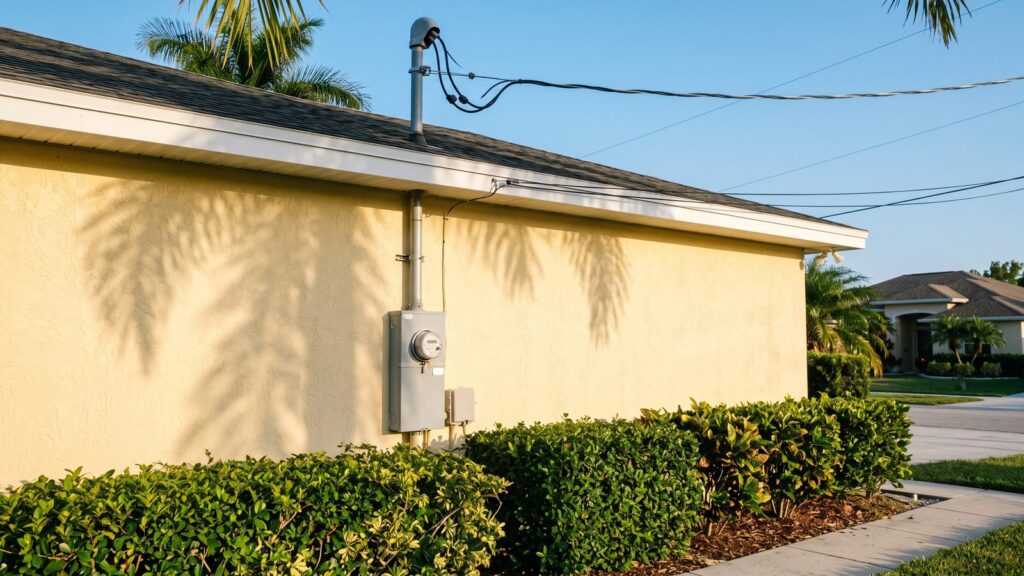
FPL owns the service line that runs from the pole or transformer to your house, and it owns the electric meter itself. Problems there are FPL’s to repair. Electricians are not allowed to work on FPL’s lines between the pole or transformer and the house, so if the trouble is on that side, the call goes to FPL.
The weatherhead, service mast, meter can and panel
Almost everything attached to the house is yours. FPL lists the weatherhead, the attachment hardware, the service mast (FPL also calls it the service stack), the riser, the meter can (or meter box), and the ground wire and rod as customer-owned equipment. So is everything after the meter: the main breaker, the panel and the wiring in the walls. When any of it is damaged, the repair has to be made by a licensed electrician.
Why FPL may not reconnect until damaged equipment is repaired
If FPL finds a hazardous condition on customer-owned equipment, it disconnects service, and power stays off until a licensed electrician repairs the hazard. The electrician handles any required permit and inspection and then notifies FPL so service can be restored. This is why some homes stay dark after a hurricane even though the rest of the street is back on.
FPL also notes that its Care To Share program may help eligible customers with repairs such as meter cans and weatherheads. For the wider picture after a storm, see what to do with your electrical system after a hurricane.
When a Partial Outage Needs a Licensed Electrician
Call an electrician when any of these is true:
- A breaker will not reset, or trips again as soon as you turn it on.
- Your neighbors have power, and FPL has checked its line and meter and found them working.
- You can see damage to the weatherhead, service mast or meter can.
- Lights keep brightening and dimming after FPL has checked its side.
- There is heat, a burning smell or noise at the panel.
- The same rooms keep losing power.
Most of these repairs are routine once the cause is found: a failed main breaker, a corroded connection in the meter can, or storm damage where the service enters the house. Kasper Electrical’s residential work includes service changes and meter can replacement, along with the permit and inspection FPL needs before it reconnects.
Frequently Asked Questions
Is a partial power outage dangerous?
It depends on the cause. A tripped breaker is the system doing its job. With a lost leg, FPL says it is safe to use the outlets that still work while you wait for repairs. A failing neutral is different: uneven voltage can overheat wiring and damage appliances, so turn off major appliances and call FPL promptly.
Should I call FPL or an electrician first?
If your neighbors are out too, call FPL. If only your home is affected, check the breakers and GFCI outlets first. If those are fine, report it to FPL so they can check their line and meter. If FPL finds its equipment working, or you can see damage on the house, call a licensed electrician.
Can a bad main breaker cause half the house to lose power?
Yes. A main breaker has two poles, one for each leg. A worn contact or a loose connection on one pole can cut one leg while the other keeps working, which looks exactly like a utility problem from inside the house. An electrician can test for it. Replacing a main breaker is not a do-it-yourself job, because the wires feeding it stay energized.
Why do my lights get brighter when a big appliance turns on?
Lights that get brighter when the air conditioner or dryer starts are a common sign of a loose neutral. FPL notes that voltage swings of more than six volts from the 120-volt standard can make lights dim or brighten. Have FPL and an electrician check the connections soon. This symptom usually gets worse, not better.
Get Help From a Licensed Palm Beach County Electrician
If the checks above point to your side of the meter, Kasper Electrical can find the cause and repair it. Our licensed electricians handle electrical troubleshooting and repairs for homes across Palm Beach and Martin Counties, including the service equipment FPL requires you to fix before it restores power. Request an appointment and tell us what is and is not working.
Sources: Florida Power & Light, Power Disturbance FAQ and Hazard Identification Process, both read October 2026.
Written by the Kasper Team at Kasper Electrical Inc. — Florida Certified Electrical Contractor EC0001409, serving Palm Beach and Martin Counties since 1978. Last updated: October 20, 2026.